Nursing Faculty Jobs: Pay, Demand, Paths
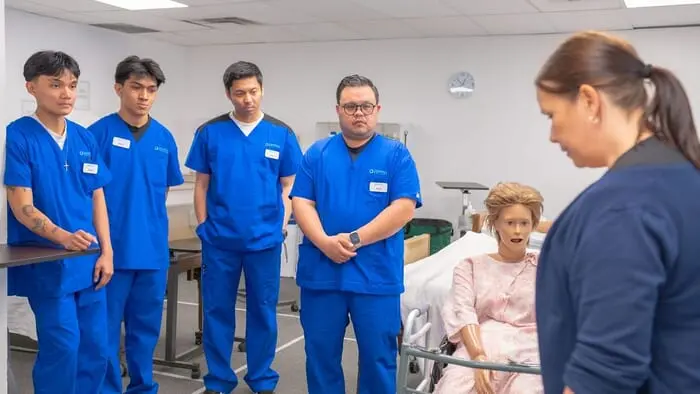
Short answer: nursing schools need more teachers than they can find. In an October 2025 survey of 863 schools, the American Association of Colleges of Nursing (AACN) counted 1,588 unfilled full-time faculty positions, and in 2025 programs turned away 93,176 qualified applications, partly for lack of faculty. Nursing instructors at colleges earned a median of $80,250 in May 2025, less than the $97,550 median for registered nurses, and pay ranges from $62,210 in West Virginia to $129,530 in Hawaii. Hover over the map to see your state.
By the AcademicCareers.com editorial team · Updated October 14, 2026 · 11-minute read
Nursing faculty at a glance
- 1,588 unfilled full-time faculty positions at 863 nursing schools (AACN, October 2025)
- 80.9% of those vacancies require or prefer a doctorate
- $80,250 median pay of nursing instructors and teachers at colleges, May 2025 (BLS)
- 17% projected growth in nursing faculty jobs from 2025 to 2035, against 3 percent for all occupations (BLS)
- 85% of a Nurse Faculty Loan Program loan can be cancelled after four years of full-time teaching (HRSA)
In this guide
Why nursing schools need faculty
In its October 2025 survey of 863 nursing schools, AACN found 1,588 unfilled full-time faculty positions, a vacancy rate of 7.2 percent, down from 7.9 percent in 2024. Schools also said they needed 150 more positions to keep up with student demand.
The shortage limits how many nurses the country can train. In 2025, nursing programs turned away 93,176 qualified applications, including 75,255 to entry-level bachelor's programs, 9,859 to Doctor of Nursing Practice (DNP) programs, 6,496 to master's programs and 500 to PhD programs. Schools cite too few clinical sites, faculty and preceptors, too little space and tight budgets.
Demand will keep rising. The Bureau of Labor Statistics (BLS) counted 96,100 jobs for nursing instructors and teachers at colleges in 2025 and projects 112,600 by 2035, growth of 17 percent against 3 percent for all occupations. On AcademicCareers.com, 98 nursing jobs were live in October 2026, and 81 job alerts use the keyword “nursing”.
Nursing faculty pay by state
The map shows the median annual wage of nursing instructors and teachers at colleges and universities in each state, from the BLS survey of employers in May 2025. Hover over a state, or tap it on a phone, for the average and the pay of the lowest- and highest-paid 10 percent.
See every state in a table
| Rank | State | Median salary | Average salary | Lowest 10% earn under | Top 10% earn over |
|---|---|---|---|---|---|
| 1 | Hawaii | $129,530 | $125,620 | $103,160 | $129,640 |
| 2 | District of Columbia | $107,770 | $109,610 | $65,250 | $173,600 |
| 3 | Delaware | $98,170 | $99,500 | $61,800 | $137,820 |
| 4 | Nevada | $96,500 | $89,750 | $57,670 | $121,190 |
| 5 | Connecticut | $95,500 | $94,470 | $60,790 | $130,380 |
| 6 | Idaho | $90,890 | $93,950 | $46,940 | $145,940 |
| 7 | Alaska | $85,650 | $97,020 | $60,530 | $133,090 |
| 8 | Massachusetts | $85,130 | $95,000 | $62,200 | $138,240 |
| 9 | Texas | $84,930 | $96,030 | $50,760 | $137,530 |
| 10 | Wisconsin | $84,700 | $87,000 | $53,760 | $114,440 |
| 11 | Maryland | $84,050 | $88,480 | $33,830 | $126,460 |
| 12 | New York | $82,950 | $91,290 | $49,840 | $145,230 |
| 13 | Nebraska | $82,720 | $89,010 | $62,980 | $121,250 |
| 14 | Virginia | $82,550 | $85,480 | $57,380 | $118,110 |
| 15 | Colorado | $82,530 | $86,560 | $39,850 | $127,800 |
| 16 | Florida | $82,410 | $83,110 | $56,830 | $109,910 |
| 17 | Utah | $82,320 | $79,910 | $50,190 | $106,850 |
| 18 | California | $81,960 | $96,830 | $47,840 | $164,450 |
| 19 | Washington | $81,630 | $92,500 | $58,320 | $133,840 |
| 20 | Minnesota | $81,280 | $87,310 | $61,760 | $123,810 |
| 21 | North Dakota | $80,710 | $85,640 | $61,020 | $106,380 |
| 22 | North Carolina | $80,400 | $85,230 | $59,770 | $110,620 |
| 23 | Tennessee | $80,050 | $82,240 | $60,090 | $109,830 |
| 24 | Louisiana | $79,960 | $87,790 | $49,370 | $127,910 |
| 25 | Alabama | $79,690 | $82,800 | $48,100 | $122,930 |
| 26 | Maine | $79,600 | $84,150 | $59,970 | $118,810 |
| 27 | South Carolina | $79,540 | $88,730 | $60,510 | $128,210 |
| 28 | New Mexico | $79,380 | $75,960 | $42,680 | $109,880 |
| 29 | Illinois | $79,150 | $78,320 | $47,690 | $103,220 |
| 30 | Arizona | $78,980 | $84,560 | $50,400 | $119,880 |
| 31 | Michigan | $78,870 | $81,190 | $36,400 | $124,460 |
| 32 | Pennsylvania | $78,460 | $80,100 | $47,280 | $107,640 |
| 33 | Rhode Island | $78,340 | $81,060 | $50,890 | $106,220 |
| 34 | New Hampshire | $78,310 | $81,420 | $63,100 | $102,870 |
| 35 | Oregon | $78,050 | $84,450 | $46,900 | $130,810 |
| 36 | Montana | $77,980 | $76,960 | $48,560 | $99,800 |
| 37 | Georgia | $77,720 | $78,320 | $44,480 | $111,820 |
| 38 | Iowa | $77,360 | $78,050 | $49,450 | $104,820 |
| 39 | New Jersey | $76,980 | $83,650 | $32,220 | $128,910 |
| 40 | Ohio | $76,700 | $73,110 | $31,380 | $101,340 |
| 41 | Missouri | $76,340 | $80,930 | $48,610 | $119,050 |
| 42 | Indiana | $76,080 | $78,950 | $48,740 | $107,420 |
| 43 | Mississippi | $75,060 | $78,460 | $61,150 | $106,400 |
| 44 | Wyoming | $72,590 | $71,940 | $49,360 | $101,580 |
| 45 | Kentucky | $71,920 | $76,560 | $47,730 | $105,880 |
| 46 | Oklahoma | $67,840 | $70,440 | $51,780 | $84,830 |
| 47 | Vermont | $66,660 | $76,960 | $63,510 | $95,600 |
| 48 | South Dakota | $66,630 | $74,120 | $59,160 | $97,260 |
| 49 | Arkansas | $63,090 | $67,790 | $48,960 | $93,060 |
| 50 | Kansas | $62,870 | $69,990 | $47,940 | $91,220 |
| 51 | West Virginia | $62,210 | $67,250 | $47,400 | $90,270 |
Hawaii stands out at $129,530, followed by the District of Columbia ($107,770) and Delaware ($98,170). West Virginia has the lowest median, $62,210. Pay does not simply follow living costs: California, one of the most expensive states, sits close to the national median of $80,250 at $81,960.
Two cautions: most faculty salaries cover a nine-month academic year, so summer teaching and clinical work come on top, and the figures mix every rank, from new instructors to full professors.
Teaching pay vs. clinical pay
AACN notes that higher pay in clinical practice draws nurses away from teaching, and the BLS figures show why:
| Occupation | Median pay, May 2025 |
|---|---|
| Nursing instructors and teachers, postsecondary | $80,250 |
| All postsecondary teachers | $85,330 |
| Registered nurses | $97,550 |
| Nurse practitioners | $132,300 |
The comparison is not like for like: a hospital salary covers twelve months, often with nights and weekends, while a faculty salary usually covers nine months of mostly weekday work. Many nurse educators also keep practicing part-time, which keeps their skills current.
Worked example (fictional). Dana, a critical care nurse earning $98,000, is offered $82,000 for a nine-month lecturer position. A summer course and a per diem shift or two a month would recover part of the $16,000 gap. If she borrowed $40,000 through the Nurse Faculty Loan Program for her master's degree, $34,000 would be cancelled over her first four years of full-time teaching. Run your own numbers the same way.
The roles nursing schools hire for
Many nurse educators hold several of these roles over a career. Clinical appointments differ from the tenure track; see our guide to clinical faculty jobs.
| Role | What you do | Usual minimum | Typical terms |
|---|---|---|---|
| Clinical instructor | Supervise a small group of students in a hospital, clinic or community setting | Graduate degree preferred; some states accept a BSN | Part-time, per clinical group or course |
| Simulation educator | Run simulation scenarios and skills labs, and debrief students | BSN or MSN plus strong clinical experience | Full- or part-time; faculty or staff |
| Lecturer or instructor | Teach courses, labs and clinicals; advise students | Master's degree in nursing | Full-time, renewable contracts |
| Tenure-track professor | Teach, do research, win grants and mentor graduate students | PhD, or a DNP at some schools | Probationary years, then tenure review |
| Program director or dean | Lead a program's faculty, budget and accreditation | Doctorate plus leadership experience | Usually a twelve-month administrative appointment |
Online RN-to-BSN and graduate programs also hire remote faculty; see online instructor jobs.
Degrees and credentials
Master's degree. A master's in nursing is the usual minimum for full-time teaching. A nursing education focus helps, but schools also hire clinical specialists, such as nurse practitioners, to teach their specialty.
Doctorate. AACN found that 80.9 percent of vacant faculty positions required or preferred a doctorate. The PhD is a research degree and the usual route to the tenure track at research universities. The DNP is a practice doctorate, common among faculty who teach advanced practice and clinical courses.
Certified Nurse Educator (CNE). This National League for Nursing (NLN) credential shows expertise in the full faculty role. You qualify with a valid RN license and a graduate degree in nursing plus one of three things: a nursing education focus, a post-master's certificate in nursing education, or at least nine graduate credits in education courses. A graduate nursing degree in another area also qualifies if you have worked two years in an academic nursing program within the past five. The exam has 150 multiple-choice questions and costs $425 for NLN members or $525 for others in 2026, and certification lasts five years.
Certified Academic Clinical Nurse Educator (CNE®cl). A separate NLN credential for clinical teaching, open to nurses with a BSN, three years of practice and two years of teaching in an academic nursing program, simulation included, within the past five years. A graduate degree focused on nursing education plus three years of practice also qualifies.
Help paying for a graduate degree
The federal Nurse Faculty Loan Program (NFLP), run by the Health Resources and Services Administration (HRSA), funds accredited nursing schools, which lend to graduate students preparing to teach. The loans carry a low interest rate, and after graduation part of the loan, plus interest, is cancelled for each year you work full-time as nurse faculty:
| Year of full-time faculty service | Share cancelled | On a $40,000 loan |
|---|---|---|
| Year 1 | 20% | $8,000 |
| Year 2 | 20% | $8,000 |
| Year 3 | 20% | $8,000 |
| Year 4 | 25% | $10,000 |
| Total | 85% | $34,000 |
Only participating schools offer these loans, so ask before you enroll. If you already work at a college, ask about tuition benefits too: BLS notes that many colleges let full-time employees take classes at a discount or for free.
Moving from practice to teaching
You do not have to leave practice to start teaching. Most of the steps below fit around a nursing schedule.
From bedside to classroom
Click each step for what to do and when.
Example (fictional). Maya, an emergency nurse with a BSN and eight years of experience, precepts new graduates for a year, then teaches one clinical group a semester while keeping three shifts a week. She completes an online MSN in nursing education at a school in the loan program, earns the CNE®cl after two years of clinical teaching and applies for full-time lecturer jobs in her last semester.
How to apply
Nursing faculty applications usually ask for:
- A CV that opens with your license, certifications and clinical specialties, then teaching: students precepted, clinical groups and courses taught, and in-service programs you ran.
- A cover letter that names what you can teach, such as medical-surgical or pediatric nursing, and your experience with clinical groups or simulation.
- A teaching philosophy statement for most full-time jobs. Build it on real moments with students; see how to write a teaching philosophy statement.
- Transcripts, license verification and references, ideally from a nurse leader who has seen you teach or precept.
Full-time searches often include a teaching demonstration: a short class session or a simulation with a debrief. Describe your clinical work in teaching terms on your CV:
| Instead of | Write |
|---|---|
| Charge nurse, medical-surgical unit | Precepted 14 new graduate nurses and 22 BSN students over three years; wrote the unit orientation checklist now used hospital-wide |
| Member, education committee | Designed and taught a four-hour sepsis recognition course for 120 nurses |
| Rapid response team | Led monthly mock codes with structured debriefs for students and staff |
When an offer arrives, compare the workload as well as the salary: credits or contact hours a term, clinical supervision, summer duties and whether you may keep practicing. Our guide to negotiating a faculty job offer covers what to ask for.
For nursing schools: how to fill faculty jobs
With vacancies across the country, candidates can choose. Make the decision easy:
- Publish the salary range. Nurses compare every offer with clinical pay, and 14 states and the District of Columbia now require pay ranges in job ads; see pay transparency laws for job ads.
- Spell out the workload: classroom credits, clinical groups, simulation hours, summer duties and whether faculty may keep practicing.
- Offer more than one way in: part-time clinical appointments, joint appointments with partner hospitals and support for graduate study.
- Post early. Nearly half of all job postings on AcademicCareers.com are bought between August and November. A single posting costs $295 for 90 days and goes to job seekers whose alerts match; bundles save 15 to 30 percent, and Unlimited Annual Plans cover every opening for a year. See posting options.
Find your next nursing faculty position
Clinical instructor, lecturer, tenure-track and leadership openings at nursing schools, with new jobs every day.
Nursing faculty jobsGet free job alertsFrequently asked questions
How much do nursing professors make?
Nursing instructors and teachers at colleges earned a median of $80,250 in May 2025 (BLS); state medians range from $62,210 in West Virginia to $129,530 in Hawaii. Pay rises with rank, and across all fields AAUP finds that faculty at doctoral universities earn the most at every rank.
Is there a shortage of nursing faculty?
Yes. AACN's October 2025 survey found 1,588 unfilled full-time faculty positions at 863 schools, a vacancy rate of 7.2 percent, down from 7.9 percent in 2024. Programs still turned away 93,176 qualified applications in 2025.
Can I teach nursing with a BSN?
Sometimes, in clinical settings. Some states and schools let nurses with a BSN supervise clinical groups, often while they complete a graduate degree. Classroom and full-time positions usually require at least a master's degree in nursing.
Do I need the CNE to teach nursing?
No. The National League for Nursing's Certified Nurse Educator credential is voluntary, though some job ads list it as preferred. It requires an RN license and a graduate nursing degree plus education coursework or two years of academic teaching, and it lasts five years.
Can I keep working as a nurse while I teach?
Yes. Many nursing faculty keep a clinical role, often per diem or in the summer. Check your contract for limits on outside work, and ask whether practice can count toward your workload.
How can I pay for a graduate degree to teach nursing?
Start with the federal Nurse Faculty Loan Program: low-interest loans through participating schools, with up to 85 percent of the loan plus interest cancelled over four years of full-time teaching. Employer tuition benefits can cover more.
Sources
- AACN, Nursing Faculty Shortage fact sheet (vacancy survey, October 2025; 2025-2026 enrollment and graduations) (link)
- U.S. Bureau of Labor Statistics, Occupational Outlook Handbook: Postsecondary Teachers (May 2025 pay, 2025-35 projections) (link)
- BLS, Occupational Outlook Handbook: Registered Nurses (link)
- BLS, Occupational Outlook Handbook: Nurse Anesthetists, Nurse Midwives, and Nurse Practitioners (link)
- BLS, Occupational Outlook Handbook: Postsecondary Education Administrators (employee tuition benefits) (link)
- BLS, Occupational Employment and Wage Statistics, May 2025 state estimates (map) (link)
- HRSA, Nurse Faculty Loan Program (link)
- National League for Nursing, CNE eligibility (link)
- National League for Nursing, CNE candidate handbook 2026 (link)
- National League for Nursing, CNEcl candidate handbook 2026 (link)
- AAUP, Annual Report on the Economic Status of the Profession, 2025-26 (link)
- AcademicCareers.com job, alert and posting data, October 2026
- Map: U.S. Census Bureau state boundaries via the us-atlas project (link)