Faculty Interview Questions and Answers
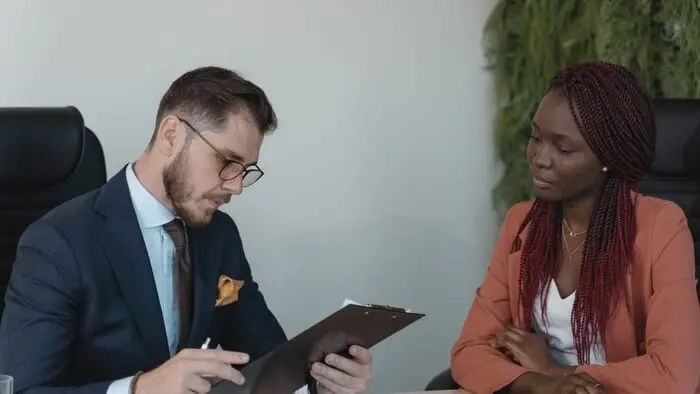
Short answer: most faculty searches have two interview rounds: a short first-round interview with the search committee, now usually by video, and a campus visit of one or two days for a few finalists. The questions are predictable: your research, your teaching, how you support and mentor students, service and fit, and what you would need to succeed. Practice 30 of them with the flashcards below, then read three sample answers and a campus visit schedule.
By the AcademicCareers.com editorial team · Updated October 14, 2026 · 12-minute read
Faculty interviews at a glance
- 2 rounds a short first-round interview, then a campus visit for a few finalists
- 1-2 minutes the right length for most answers, built around one specific example
- 30-40 minutes for a typical job talk, followed by 20 to 30 minutes of questions
- 48 hours the window for sending thank-you notes after an interview
- Before an offer employers may not ask about disability, and should avoid questions about family, age or religion
In this guide
- How faculty interviews work
- Practice with 30 common questions
- How to answer, with three sample answers
- The campus visit: a sample schedule
- The job talk
- The teaching demonstration
- Video interview tips
- Questions they shouldn't ask, and how to respond
- After the interview: thank-you notes and follow-up
- Frequently asked questions
How faculty interviews work
The University of Illinois Graduate College describes the pattern most searches follow: a screening interview, then at least one campus interview.
- First round. Usually a video call with the search committee; conference interviews, still used in some fields, typically last about half an hour. Expect questions on research, teaching and fit, then time for yours.
- Campus visit. Illinois says the top three or four candidates are typically invited for one or two days, and the University of Washington's career center says visits can run up to three. Expect a job talk or teaching demonstration, meetings with faculty, the chair, the dean and students, a tour and several meals.
- Decision. Reference checks, approvals and, for one candidate, an offer, usually from the chair or dean.
Community colleges often work differently. Many use a hiring panel of faculty, staff and administrators who ask every candidate the same questions, often with a teaching demonstration in the same session, and then send finalists to meet the president or a vice president. Expect the questions to center on teaching and student success. See current community college faculty jobs.
Timing. Nearly half of all job postings on AcademicCareers.com are bought between August and November, so first-round interviews for many assistant professor and tenure-track searches fall in late fall and winter. Prepare before the invitations arrive.
Practice with 30 common questions
These questions come up again and again, from the first video call to the dean's office. Read each one, answer out loud, then reveal the tip. The University of Washington's career center suggests keeping most answers to one or two minutes and using specific examples rather than abstract principles.
Faculty interview flashcards
30 questions across ten stages of a faculty search, from the first video call to your own questions for the committee. Answer out loud, then tap Show tip. Next question moves through a shuffled deck.
Prepare your research summary in several lengths: UW's career center suggests ten seconds, one minute, ten minutes and thirty minutes. Reread your cover letter and CV before every interview, too; anything in them is fair game.
How to answer, with three sample answers
A simple structure keeps answers short and concrete. UW's career center recommends the STAR method: the situation, the task, the action you took and the result.
Here is how a fictional candidate, Dr. Maya Ortiz, an environmental chemist applying to a regional public university, might answer three questions she is sure to hear.
"Tell us about your research."
"I study how restored urban wetlands clean stormwater. Many cities restore wetlands, but we know little about which designs remove the most nitrogen. After two years of monthly sampling at six sites, I found that plant diversity predicts removal better than wetland size, and one city is now using that finding in its restoration plan. Next, I want to test whether it holds in colder climates, in a project designed so undergraduates can run much of the field work."
"Why do you want to work here?"
"Two reasons. First, your summer research program: it's the setting where my field projects work best. In my postdoc, three undergraduates have run their own sampling sites, and one is presenting at a regional meeting this spring. Second, your students. Many of them work while they study, as many of mine do, and I've built my courses around that, with recorded problem walkthroughs and practice quizzes they can do on a phone."
"How would you teach our introductory course?"
"I'd keep your current sequence and add a thread that runs through the semester. In week three, students collect a water sample from home, and later units use it to practice stoichiometry, solutions and acid-base chemistry. Each unit ends with a short, low-stakes quiz so I can see who needs help before the exam. In my last course, that meant I reached struggling students in week five instead of week twelve."
Each answer takes about a minute to say, gives one concrete example and ties back to the department.
The campus visit: a sample schedule
No two schedules match, but many look like this one. Ask for your itinerary in advance, as Illinois advises, and plan to arrive the evening before.
| Time | Event | What to prepare |
|---|---|---|
| Evening before | Dinner with two members of the search committee | Questions about the department and the area |
| 8:00 a.m. | Breakfast with the search chair | Your interest in the job; questions about the day |
| 9:00 a.m. | Meeting with the department chair | Teaching load, courses, expectations for tenure |
| 10:00 a.m. | One-on-one meetings with faculty, 30 minutes each | A question for each person; short versions of your research |
| 11:30 a.m. | Lunch with students, no faculty present | Questions about their courses and research |
| 1:00 p.m. | Teaching demonstration | Your lesson, handouts and a backup plan |
| 2:30 p.m. | Meeting with the dean | The institution's priorities, support for new faculty, what you would need |
| 3:30 p.m. | Campus tour: library, labs or studios | Questions about facilities |
| 4:00 p.m. | Job talk and questions | A talk of 30 to 40 minutes, then questions |
| 6:30 p.m. | Dinner with faculty | Easy conversation, light on alcohol |
As Illinois's Graduate College puts it, you will have very few moments when you are not being evaluated, meals included. UW's career center suggests ordering food that's easy to eat while you talk and packing snacks for short breaks.
The job talk
The job talk, also called a seminar or colloquium, is a research presentation to the whole department. UW's career center describes a typical format of 30 to 40 minutes of presenting and 20 to 30 minutes of questions. Your audience will mix specialists, faculty from other subfields and students, so Illinois suggests an arc that starts with background everyone can follow, moves through your approach and results, and ends by relating the work to the big picture.
- Spend the first minutes on why the question matters, in plain language.
- Make your own contribution unmistakable: what you did, what you found and what it changes.
- Close with next projects you could run at this institution, with its students.
- Finish on time, leaving the full question period.
- Rehearse before an audience, check the room and equipment, and bring a backup of your slides.
Some research universities also ask for a chalk talk: an informal session, usually at a whiteboard, on your future research, funding and lab plans. Ask whether one is expected.
The teaching demonstration
Illinois notes that teaching demonstrations are more common at smaller institutions and in some disciplines; at community colleges and liberal arts colleges, expect one. It may be a real class, faculty playing students or a lesson on a topic you choose.
Ask beforehand for the topic and level, the length, who will attend, what students have covered and what technology the room has. Then plan a lesson, not a talk: one goal stated at the start, a short explanation, an activity such as a problem in pairs or a quick poll, and a check of understanding before you finish. Treat the faculty as the students they're playing and keep to time. If the projector fails, carry on at the whiteboard; how you recover is part of the demonstration. Your teaching statement is good preparation, because the lesson should look like the classroom it describes.
Video interview tips
- Use a reliable computer with a good camera and microphone, a wired connection if you can and a quiet, private room, as UW's career center advises.
- Light your face from the front, set the camera at eye level and look into it when you speak.
- Keep notes to a few words, check what's behind you and dress as you would on campus.
- Learn the interviewers' names and let each person finish before you answer.
- Test the platform the day before, log in early and keep the chair's phone number handy in case the call drops.
Questions they shouldn't ask, and how to respond
Federal law bars employers from asking about disability before a job offer. The U.S. Equal Employment Opportunity Commission also advises against pre-employment questions that touch on race, sex, national origin, age or religion, and lists questions about marriage, pregnancy, children, child care and a spouse's job as possible evidence of discrimination.
Such questions usually come up casually, often over dinner, from someone trying to be friendly. You don't have to answer. UW's career center suggests working out the concern behind the question, usually whether you can do the job, and answering that:
Question: "Do you have kids? Our schools are great."
Response: "It sounds like a wonderful place to live. I'm ready to take on the full teaching schedule and service this position involves, and I'd love to hear more about the community."
You can choose to share personal information, for example to ask about partner hiring; many candidates wait until after an offer. If a question troubles you, you can raise it later with the institution's human resources or equal opportunity office.
After the interview: thank-you notes and follow-up
Within 48 hours, send short thank-you notes or e-mails to the chair and anyone you spent significant one-on-one time with, such as committee members and the dean, as UW's career center recommends. Thank them, confirm your interest, mention one specific moment and send anything you promised.
Dear Dr. Chen,
Thank you for hosting me on Thursday. I especially enjoyed hearing your students describe their river monitoring project, and the visit confirmed how much I would like to join the department. As promised, I've attached the syllabus for my environmental methods course.
Best regards,
Maya Ortiz
Submit travel receipts promptly; Illinois notes the institution normally reimburses campus-visit expenses unless it says otherwise. Then be patient, since references, approvals and other candidates' visits take time. Ask about the timeline before you leave, and send one polite check-in if that date passes. When an offer arrives, read our guide to negotiating a faculty job offer before you reply.
Ready for your next interview?
Faculty, staff and administrative jobs at colleges and universities, with new openings every day.
Tenure-track jobsGet free job alertsFrequently asked questions
What questions are asked in a faculty interview?
Expect questions about your research and future plans, your teaching and the courses you could teach, how you support and mentor students, service, why you want this job and what you would need to succeed.
How long is a faculty campus interview?
Usually one or two days, sometimes three, with a job talk or teaching demonstration, meetings and meals. First-round interviews are much shorter, often about half an hour.
What should I wear to a faculty interview?
Business or business casual, in line with the department's norms, and comfortable shoes for walking between buildings. UW's career center notes it is better to be a little more formal than other candidates than less.
How many candidates get a campus interview?
Usually three or four, according to Illinois's Graduate College; the University of Washington's career center puts the range at one to five.
Should I ask about salary during a faculty interview?
Not during the interviews; UW's career center advises against it. If the dean raises it, answer briefly and save the details for after an offer.
How soon should I follow up after a campus visit?
Send thank-you notes within 48 hours. Ask about the timeline before you leave, and if that date passes, one short, polite check-in with the chair is fine.
Sources
- University of Washington Career and Internship Center: Academic Interviews (link)
- University of Illinois Urbana-Champaign Graduate College: Faculty Interviewing (link)
- U.S. Equal Employment Opportunity Commission: Prohibited Employment Policies/Practices (pre-employment inquiries) (link)
- U.S. Equal Employment Opportunity Commission: Pre-Employment Inquiries and Marital Status or Number of Children (link)
- AcademicCareers.com posting data, August 2019 to October 2026 (share of postings bought by month)